A Tour of Megastructures in Science Fiction: When Artificial Structures Become Worlds
Standing on Earth and looking up, we see the horizon stretching into the distance and the sky arching overhead. But in science fiction, a class of creations known as megastructures overturns this familiar sense of space.
The term “megastructure” originated in architecture. In 1964, Japanese architect Fumihiko Maki introduced the concept in Investigations in Collective Form, describing an enormous structural framework capable of accommodating all the functions of a city. Japan’s Metabolist movement subsequently envisioned vast modular cities whose individual units could be continually replaced.
Science fiction, however, pushed the concept to extremes architects scarcely dared imagine: a megastructure is no longer simply a very large building. It is large enough to become a world unto itself—with its own day-night cycle, gravity, weather, and ecosystems.
From physicist Freeman Dyson’s proposal in 1960 for an energy collector enveloping a star—the Dyson sphere—to Gerard K. O’Neill’s rotating cylindrical space colonies in 1974, scientists drew up the first engineering sketches for life in space. Science-fiction creators followed these ideas to build one breathtaking wonder after another.
NOTE
A clarification of Dyson sphere physics: Soon after publishing the concept in 1960, Freeman Dyson clarified in Science that a solid, fully enclosing spherical shell was mechanically impossible. The biosphere he envisioned consisted of numerous independently orbiting objects—what later became known as a “Dyson swarm.” The solid shell became a dramatized interpretation widely popularized by subsequent science-fiction films and television.
Below, we visit six classic megastructures in ascending order of engineering scale, experiencing their artificial skies, upward-curving landscapes, and even vistas that swallow an entire solar system.
Six Classic Megastructures, from Smallest to Largest
 Comparing Six Megastructures
 +-------------------------------------------------------+
 | Megastructure Scale Hierarchy                         |
 +-------------------------------------------------------+
 | O'Neill Colony (Gundam)  | Dia: 6.4 km, Length: 36 km |
 | Rama (Clarke)            | Dia: 20 km, Length: 50 km  |
 | Halo Ring (Installation) | Dia: 10,000 km             |
 | Culture Orbital (Banks)  | Dia: ~3,000,000 km         |
 | Ringworld (Larry Niven)  | Dia: 2.99x10^8 km (2 AU)   |
 | The City (BLAME!)        | Dia: ~1.6x10^9 km          |
 +-------------------------------------------------------+
1. Mobile Suit Gundam: An Artificial Sky 6.4 Kilometers Across
The 1979 series Mobile Suit Gundam brought Gerard K. O’Neill’s space-colony concept directly into Japanese anime. According to official specifications, a standard “open-type” cylindrical colony measures about 6.4 kilometers in diameter and 36 kilometers in length; as in O’Neill’s original design, it rotates once every two minutes to generate Earth-normal gravity through centrifugal force.
Inside the colony, three strips of land alternate with three enormous longitudinal windows, while external mirrors regulate the day-night cycle. Looking up, residents see the sunlit land and buildings on the opposite side, rather than an endless field of stars.
The Principality of Zeon at Side 3 instead uses “closed-type” colonies without windows, relying entirely on externally mounted solar plants for power in exchange for twice the land area. Official lore describes how, within these sealed colonies, the ideology that would later ignite a devastating war steadily took hold.
More startling still, Gundam shatters the idea of megastructures as peaceful homes in its opening, “Operation British.” Zeon forces push an entire colony, more than six kilometers across and over thirty kilometers long, out of orbit and send it crashing into Earth, unleashing catastrophe on Sydney. Here, a megastructure reveals for the first time the astonishing destructive power of becoming a weapon of catastrophe.
2. Rendezvous with Rama: A Silent Tomb Turned on a Lathe
In his 1973 novel Rendezvous with Rama, Arthur C. Clarke depicts a geometrically perfect alien cylinder—fifty kilometers long, twenty kilometers across—entering the solar system.
Clarke describes the artifact with the precision of an industrial specification: its geometry is so perfect that it seems to have been turned directly on a lathe, and it completes one rotation every four minutes. Yet it remains utterly silent:
Rama was as silent as a tomb - which, perhaps, it was. No radio signals, on any frequency; no vibrations that the seismographs could pick up… It was almost ominously quiet.
A human expedition enters through the zero-gravity region along its axis of rotation, then descends a staircase roughly eight kilometers long to reach the inner plain. Gravity gradually increases with distance from the axis. Across the inner wall runs the “Cylindrical Sea,” a dark, ring-shaped band of water ten kilometers wide.
While the expedition makes its first descent from the hub, the polar crater is already flooded with light from three widely spaced plasma arc lamps; later, as Rama draws closer to the sun, six linear suns illuminate the entire world. All its internal hatches, passageways, and life-support structures exhibit strict threefold symmetry, and Rama never responds to the human exploration. The book ends with a single, dispassionate observation: “The Ramans do everything in threes.” Clarke’s megastructure never troubles itself to explain its existence to humanity; the result is an extraordinary air of coldness and mystery.
3. Halo: A Skyline That Climbs Into the Sky
The classic 2001 game Halo let millions of players worldwide stand inside a megastructure and look up for themselves. When Master Chief steps out of his escape pod, the sky above the alien grasslands reveals not a horizon that curves away, but an immense arc of light rising vertically across the zenith.
Designated Installation 04, this ring measures 10,000 kilometers in diameter—roughly 80 percent of Earth’s diameter—and 318 kilometers in width. It has nearly Earth-normal gravity (0.992g), along with a complete natural ecology and climate.
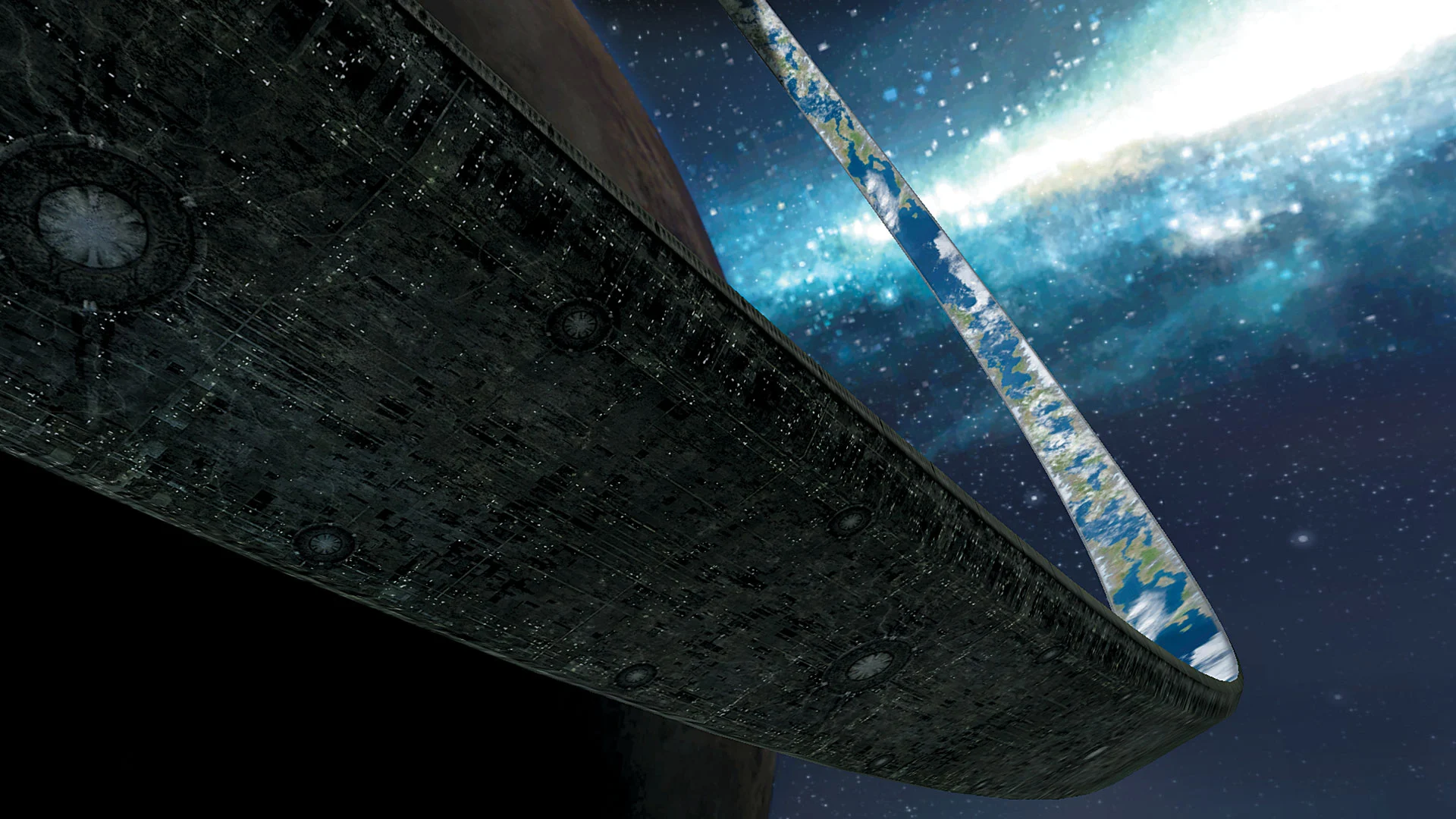
Yet this vast, seemingly paradisiacal garden is, at its core, the ultimate weapon of galactic extermination, built by the ancient Forerunners. When a ring fires, a pulse of radiation propagates faster than light, instantly wiping out all intelligent life within a radius of 25,000 light-years; fired together, the seven rings deny the Flood its hosts across the entire galaxy, starving the parasite to death. Afterward, the picturesque grasslands remain untouched—except that nothing capable of thought is left alive on them.
4. The Culture’s Orbitals: Elegant, Practical Artificial Horizons
Iain M. Banks’s Culture series offers a thoroughly pragmatic refinement of the megastructure. In his 1994 essay “A Few Notes on the Culture”, he vividly explains the reasoning behind the Orbital’s design:
Rather than expend enormous resources building a Dyson sphere around an entire star or a colossal ringworld, the better course is to shrink the ring to about three million kilometers across—roughly eight times the distance between Earth and the Moon—and set it circling its star at a particular tilt. As the ring rotates, different areas of its inner surface periodically face toward or away from the sunlight, naturally providing Earth-normal gravity (1g) and a 24-hour day-night cycle, without elaborate shading mechanisms.
A standard Orbital can comfortably accommodate tens of billions of residents on its verdant inner surface. Yet in Consider Phlebas, the Vavatch Orbital, with a circumference of fourteen million kilometers, is marked for destruction during an interstellar war. It gradually unravels and breaks apart in space, and the scene lays bare the fragile, tragic side of utopian architecture.
5. Ringworld: An Endless Ring Without a Horizon
In his 1970 novel Ringworld, Larry Niven distills the star-enclosing Dyson sphere into an immense ring surrounding a sun. The ring measures 299 million kilometers across—equivalent to the diameter of Earth’s orbit—and 1.6 million kilometers wide. Its inner surface has an area equivalent to three million Earths.
The ring rotates at approximately 1,240 kilometers per second to generate gravity close to Earth-normal. Immensely strong walls tower 1,600 kilometers high along its edges to contain the atmosphere. In an orbit just inside the ring, a series of shadow squares connected by exceptionally strong, thin wires regularly passes across the star like a set of blinds, orchestrating the alternation of day and night.
For travelers arriving on Ringworld, the first familiar feature to disappear is the horizon:
The Ringworld had no horizon. There was no line where the land curved away from the sky. Rather, earth and sky seemed to merge in a region where details the size of continents would have been mere points…
Look up, and the land beneath your feet no longer disappears beyond the horizon. Instead, it follows an endless curve all the way toward the zenith—the ground beneath you becomes the sky overhead. This mechanically unstable behemoth, with its precisely specified rotation and subsequently added attitude-correction engines, became one of hard science fiction’s most iconic feats of engineering.
6. BLAME!: An Uncontrolled City That Devours the Solar System
Tsutomu Nihei’s BLAME!, which began serialization in 1997, is one of the few celebrated works of science fiction to place the “Megastructure” directly at the heart of its world.
In the story, genetic mutations cause humanity to lose its access privileges, leaving the City’s automated construction system out of control and endlessly replicating itself. Layer upon layer of megastructure completely engulfs Earth, expanding outward to the edge of the solar system. According to specifications in the art book, the layered City extends to Jupiter’s orbit—a diameter of roughly 1.6 billion kilometers.
Armed with a Gravitational Beam Emitter capable of penetrating the Megastructure, the protagonist Killy journeys alone for more than a thousand years through endless, cold steel and layered structures, searching for humans who possess the “Net Terminal Gene” so that the control system can be restarted.
Where Ringworld offers an openness without visible boundaries, BLAME! evokes the extreme claustrophobia of a world you can never walk out of. In this world, the “sky” has long ceased to exist. Overhead, there is always another artificial floor slab, tens of thousands of kilometers thick.
Why Does Science Fiction Keep Building Megastructures?
Why are science-fiction writers and creators so fascinated by enormous structures? In terms of narrative aesthetics and function, megastructures serve three distinctive purposes:
- Science fiction’s “Stonehenge” and archaeological puzzles: The “BDO” (Big Dumb Object), a term introduced by critic Roz Kaveney in 1981, is a defining feature of such works. Rama and megastructures resembling black monoliths recast alien civilizations as “ruins” rather than “characters.” The story centers on the archaeology and mysteries of immense ancient artifacts, rather than interstellar diplomacy.
- An intense experience of the sublime: The eighteenth-century philosopher Edmund Burke observed that “Greatness of dimension is a powerful cause of the sublime.” Upward-curving skylines, rings spanning millions of kilometers, and floor slabs that engulf a solar system shatter our everyday sense of scale, delivering a psychological shock that combines beauty with awe.
- The ultimate vessel for an entire civilization: A megastructure forms a complete, enclosed world, making it an ideal setting for exploring utopian and dystopian systems. Be it a free paradise of the post-scarcity age, an isolated breeding ground for totalitarian militarism, or an uncontrollably proliferating technological black hole, a megastructure offers the most extreme arena for social experimentation.
The Essence of Megastructures: Forging a New Sky for Humanity
Across science fiction’s vast spectrum, how can we decide whether a creation qualifies as a “megastructure”? Three broad criteria offer a guide:
- Engineering scale: It exceeds humanity’s existing engineering capabilities by several orders of magnitude.
- A world unto itself: It sustains its own atmosphere, day and night, gravity, and ecological cycles, rather than merely being an enclosed building.
- Narrative centrality: The structure and spatial properties of the creation itself directly form the story’s central setting or key mystery.
Take the Death Star in Star Wars. Although it measures over a hundred kilometers in diameter and has planet-destroying power, it has no independent ecology or day-night cycle of its own. At its core, it is an enormous mobile military fortress.
Perhaps the most poignant distinction between a megastructure and a mere superweapon is whether it invites life to dwell within it—whether, deep in the cold emptiness of the universe, it uses steel and gravity to forge a new sky for humanity to gaze up at.